

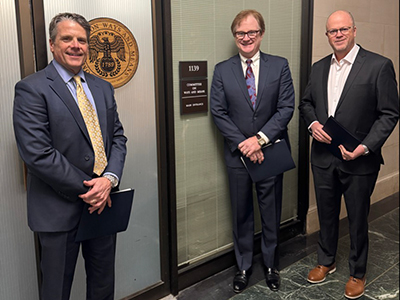
Leaders from independent alliance groups joined The Vision Council on Capitol Hill to advocate for affordable vision care and fair trade policies. (L to R) Dave Brown, CEO, IDOC; Jim McGrann, CEO, Advancing Eyecare; and Jason Lake, OD, general manager, PERC/Opti-Port.
ALEXANDRIA, Va.—In January, representatives from The Vision Council joined independent optometric alliance groups and eyewear manufacturers on Capitol Hill to advocate for policies that support affordable vision care, The Vision Council announced. The groups joined together to present a unified message to lawmakers, emphasizing that increased costs are jeopardizing Americans’ access to affordable eyecare. In addition, the coalition outlined how trade policies are increasing pressure on optical businesses, independent practices and patients. The group met with 11 congressional officials and staff from the energy and commerce health subcommittee, which have jurisdiction over health care policy and programs affecting access to vision care, The Vision Council said.
In those meetings, they emphasized that rising costs for prescription eyewear carry consequences for public health, educational outcomes, workforce productivity and healthy aging. The announcement noted that more than 70 percent of Americans rely on prescription eyewear.
“We appreciated the opportunity to meet with lawmakers and share real-world examples of how current trade policies are driving up costs for both businesses and patients,” said Ashley Mills, CEO of The Vision Council. “Prescription eyewear is classified as a Class I medical device, yet it does not receive the same tariff exemptions as other low-risk medical products. These policies are unintentionally limiting access to care, especially for children, seniors, and vulnerable populations.”
Notably for independent ECPs, the meetings included discussions about the challenges small- and mid-sized optical companies face. The announcement noted that the industry supports the goal of strengthening domestic production, but that limited access to raw materials like acetate, high labor and regulator costs, and ongoing tariffs are putting a strain on independent manufacturers and practices.
“Independent optometrists play a critical role in delivering accessible, high-quality eyecare in communities across the country,” said Dave Brown, president and CEO of IDOC. “By coming together on Capitol Hill with other optometric leaders, we’re ensuring lawmakers understand the real-world challenges our doctors face and the policies needed to protect patient access, support independent practices, and strengthen the future of optometry.”
“I think it is so important to represent our members in this advocacy effort,” added Jason Lake, OD, general manager, PERC/Opti-Port. “I was very grateful for the hard work The Vision Council did in laying the groundwork to help support my members and the industry as a whole.”
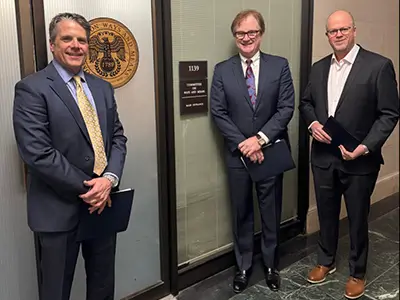
(L to R) Justin Manning, OD, chief member experience officer, PECAA; Jeff Duncan, general manager, Vision Source; and Mitch Barkley, VP of trade shows, The Vision Council.
“Independent optometrists play a critical role in patient care and overall health,” said Justin Manning, OD, chief member experience officer, PECAA. “It’s a privilege to share our members’ stories, their challenges, and the positive patient and community impact they make through eyecare with those at the highest level of government.”
Industry leaders in attendance included the following:
- Jamie Rosin, owner, Rosin Optical Co. Inc.
- Dave Brown, CEO, IDOC
- Dr. Justin Manning, chief member experience officer, PECAA
- Dr. Jason Lake, general manager, PERC/Opti-Port
- Jeff Duncan, general manager, Vision Source
- Dr. Matt Alpert, founder, TEC – The Eye Consortium
- Jim McGrann, CEO, Advancing Eyecare
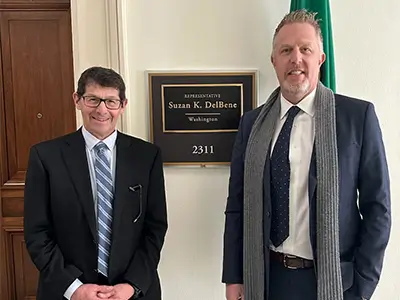
Jamie Rosin, owner, Rosin Optical Co. Inc. (l) and Dr. Matt Alpert, founder, TEC – The Eye Consortium.
“Our members want to invest, innovate, and grow here in the United States,” Mills said. “With the right policy alignment, we can protect patient access, support independent practices, and strengthen the domestic optical industry without placing additional burdens on families and taxpayers.”